powered by FreeFind
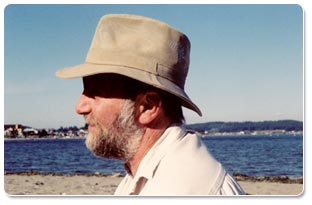
Elliott Menashe
Elliott Menashe is an environmental consultant with Greenbelt Consulting. He has written “Vegetation Management:  A Guide for Puget Sound Bluff Property Owners" (Pub. 93-31), which has become the standard shore management guidance publication for the region.

He’s the originator of the “Biostructural Engineering” approach to slope stabilization, which combines structural, bio-technical and vegetative elements to restore slopes and reduce erosion. This approach has been tested and proven effective in numerous mitigation and restoration projects.

Elliott has developed an innovative conceptual alternative to conventional shoreline armoring. The “Root Wall” concept, which uses large trees as major structural components, has been incorporated into several recent soft-shore protection projects.

He is the inventor of “EcoMulchMat,” a biodegradable wood-fiber, rolled blanket designed to reduce erosion and sediment transport, control invasive plant establishment, and accelerate the establishment of desirable vegetation. This project is currently under development.

He has lectured on shoreline management and value of vegetation at numerous symposiums, conferences, seminars and workshops sponsored by numerous Federal and State Agencies.

Elliott’s articles and technical papers (some posted on website, www.greenbeltconsulting.com), have been published in newspapers, newsletters, and conference proceedings. He has amassed a slide image library of over 1,000 slides from projects throughout the region, which he uses in classes and workshops.

Statement of Qualifications
(Last updated in Oct. 2008)
Elliott Menashe
Owner, Greenbelt Consulting, environmental consulting firm since 1987

P.O. Box 601
Clinton, WA 98236
Telephone: (360) 341-3433
UBI Number: 601-317-300
Email: elliott@greenbeltconsulting.com
www: http://greenbeltconsulting.com

Professional Speaking and Public Education:
June 25-26, 2008   Instructor, "Site Planning, Plan Review, Clearing and Grading, and Inspection", Low Impact Development Technical Workshop Series, Clallam Co, For WSU Extension.
May – June, 2006 -2008   Instructor, “Where the Water Begins:  Land Management Practices for Marine Shoreline and Bluff Property Owners”, Three-class series for King County Conservation District
March, 2006  

Instructor, “Native Plant Landscaping for Bluff Stability” For South Whidbey Community School

October 4–5, 2005 Presenter, “Workshop on Mitigating Shore Erosion Along Sheltered Coasts,” Seattle, WA. Sponsored by Ocean Studies Board of the National Academics of Science, Washington, D. C. Topic: “Value of Vegetation in Reducing Erosion”.
June 2, 2005 Instructor, “Vegetation Management for Camano Island Bluff Property Owners,” for WSU Shore Stewards Program.
Apr. 29, 2005  

Instructor, Shoreline Mgmt. and Stabilization Using Vegetation”, Camano Island, WA., for Coastal Training Program, WA., sponsored by NOAA.

April 28, 2005 Instructor, “Shoreline Management and Stabilization Using Vegetation,” Bayview, WA., for Coastal Training Program, WA., sponsored by NOAA.
April 15, 2005 Instructor, “Shoreline Management and Stabilization Using Vegetation,” Federal Way, WA, for Coastal Training Program, WA., sponsored by NOAA.
Apr. 14, 2005   Instructor, “Shoreline Mgmt. and Stabilization Using Vegetation”, Federal Way, WA, for Coastal Training Program, WA., sponsored by NOAA.
March 22–24, 2005 Instructor, “Living With The Shoreline,” for Friends of the San Juans. (3 programs)
February 17, 2005 Instructor, “Planting on the Edge,” for Hood Canal Coordinating Council.
January 20, 2005 Instructor, “Keeping Jefferson County Green,” Realtor workshop, sponsored by Jefferson County WSU Extension.
September 18, 2004 Instructor, “Hold On To Your Beach and Bluff," sponsored by King Conservation District/King Co. DNR.
April 29, 2004 Instructor, "Shoreline Management and Stabilization Using Vegetation," Camano Island, WA., for Coastal Training Program, WA., sponsored by NOAA.
April 14, 2004 Instructor, “Shoreline Management. and Stabilization Using Vegetation,” Federal Way, WA, for Coastal Training Program, WA., sponsored by NOAA.
February 12, 2004 Instructor, “Stabilizing Slopes and Reducing Erosion: Techniques and Plants,” for Northwest Gardening Connection, King County
January 31, 2004 Instructor, “Stabilizing Slopes and Reducing Erosion: Techniques and Plants,” for Island County WSU Extension.
March 13, 2003 Instructor, “Buying and Developing Rural Land,” for South Whidbey Community School.
February 23, 2003 Instructor, Northwest Flower and Garden Show seminar “Stabilizing Slopes.”
November 26, 2002 Guest Lecturer, UW Restoration Ecology Class, Seattle, WA. Topic: “Restoration for Unstable Slopes.”
October 21, 2002 Instructor, Island Land Development Issues Realtor Workshop “Low Impact Development,” sponsored by Island County WSU Extension.
Mar. 16, 2002 Instructor, “Watershed Day,” sponsored by Olympic Peninsula Waterwatchers.
December 12–13, 2001 Presenter, Native Plant Propagation and Restoration Strategies Conference, Eugene, OR., sponsored by Western Forestry and Conservation Association. Topic: “Bio-Structural Erosion Control; Incorporating Native Vegetation into Engineering Designs.”
April 2–6, 2001 Presenter, Restoration and Recovery: Beyond Good Intentions, Society of Ecological Restoration Conference, Topic: “Bio-Structural Erosion Control; Incorporating Native Vegetation into Engineering Designs.”
February 12–14, 2001 Presenter, Puget Sound/Georgia Basin Ecosystem: Status, Stressors, and the Road to Recovery Puget Sound Water Quality Action Team Conference. Topic: “Vegetation and Erosion.”
October 20–21, 2000 Instructor, “Watershed Restoration Training,” Maxwelton Salmon Adventure.
October 19, 2000 Instructor, “Forests and Development,” sponsored by South Whidbey Tilth.
April 29, 2000 Instructor, “Managing Your Timber Sale,” sponsored by WA DNR.
December 1998 Presenter, Oregon State University Conference, Native Plants: Propagation and Planting. Topic: “Vegetation and Erosion.”
April 1998 Instructor, “Using Existing Native Vegetation as Framework for Landscaping,” San Juan Nature Institute Class.
March 1998 Instructor, "Forest Health for New Landowners," for South Whidbey Community School.
March 1998 Instructor, "Managing for Slope Stability," For Center of Urban Horticulture, UW, Seattle, WA.
1998–1999 Instructor, “Living With The Coast Workshops,” for Puget Sound Water Quality Action Team. (8 programs)
October 1997 Instructor, “Preventing Tree Failures,” for South Whidbey Community School.
October 1997 Instructor, "Forest Health," Washington State University, San Juan County Workshop.
May 1997 Instructor, “Slope Management,” Washington Sea Grant seminar.
October 1996 Instructor, “Trees, Water and Wildlife,” Washington State University, Island County Extension workshop.
July–August 1996 Instructor, “Living with the Coast,” Puget Sound Action Team. (3 programs)
September 1993 Instructor, “Preserving Native Vegetation,” South Whidbey Tilth.
April 1993 Instructor, “Plant Materials and Stewardship Practices,” Washington Associatioin of Conservation Districts.
April 1993 Instructor, “Restoring Streambanks and Wetlands Using Native Plants,” Washington State University, Island County Extension.
September 1992 Instructor, “Living on the Edge: Bluffs, Beaches, and Bulkheads,” Washington State University, Island County Extension.
April 1992 Instructor, “Streambank Protection (Bio-engineering) Using Vegetation,” Washington State Department of Ecology.

Selected Consultation/Contracts:
Sept. 2006 – Present  

Technical Forestry Advisor, Whidbey Camano Land Trust

Sept. 2006 – Present  

Shoreline Management Advisor, Friends of the San Juans Landowner Assistance Project, Funded by PSAT

2005 Technical Advisor, Goosefoot Foundation, relating to tree retention.
2005 Consultant, WA. Sea Grant, relating to development of a “Marine Shoreland Planting Guide.”
2004 Technical Advisor, Interpretive Trail Development, For Whidbey Institute.
2003-2005 Program and Binder Development for curriculum, “Shoreline Management and Stabilization Using Vegetation,” classes for coastal planners, funded by NOAA, through the WA. Coastal Training Program.
2002-2004 Technical Advisor, program development for “Native Plant Salvage Project,” sponsored by South Whidbey Tilth.
2002–2003 Technical Advisor, program development for “Forest Restoration for Sustainable Wild-craft Production,” funded by Western Region, SARE.
December 2000 Island County Public Works Dept., WA. Preparation of “Final Report: Madrona Way Road Re-Alignment Project: Vegetation Management, Mitigation, and Restoration.”
April–August 1997 Whidbey Shores Homeowners Assoc. Preparation of “Integrated Management Recommendations with Regard to Slope Stability.”
April–May 1997 Birch Point Homeowners Assoc. Preparation of “Site Evaluation and Recommendations for Vegetation Management." To Maintain Slope Stability—The Pointe at Semiahmoo.
July 1996–January 1997 Whidbey Island Conservation District, WA. Assist landowners in management of small farms/woodlands to reduce non-point pollution.
November 1995– January 1996 Beach Watchers, Maxwelton Salmon Enhancement Project, Island County, WA. Technical assistance, erosion control, revegetation, trails, hazard trees, plant salvage, Forest Management.
1995 Island County Public Works Dept., WA. (1) Assessment of current roadside Vegetation management. (2) Study: “Management of Recommendations and Restoration Plan for Galbreath Road Right-of-Way,” Mar 1995. (3) Recommendations re: vegetation efforts at Saratoga Road realignment project.
October 1994/ February 1995 Lower Elwa S’Klallam Tribe, Clallam County, WA. Consulting on re-establishment of riparian vegetation community adjacent to the Hoko and Little Hoko Rivers.
September 1994 Terra Verde Forestry Services, Freeland, WA. Timber inventory.
Febbruary 1994– December 1995 Weyerhaeuser Company, Snoqualmie, WA. Quality assurance and crew training associated with silvicultural techniques of pruning.
August 1991 City of Langley, WA. Prepared study: “Vegetation Study: Cascade Avenue Site Assessment, Erosion Hazard, View Management Options.”
1987 to present Assessments, evaluations, reports and documentation regarding use approvals, wetland delineations, stream and wetland restorations, re-vegetation projects, hazard trees, forest management, and marine bluff vegetation stabilization for private individuals and homeowner associations, organizations, and agencies throughout Western Washington.

Publications:
August. 2006  

“20 Great Ways to Damage, Maim, and Kill Trees While Building Your Home”, published in Spokane County Conservation District Summer 2006 Newsletter, Spokane, WA.

June 2006  

“Where the Water Begins”, a class manual, published by King County Conservation District, Renton,WA.

2005 “Drip and Splat: A Stormwater Story,” contributing author (Primary Author, Tami Pokorny), Jefferson County Natural Resources, in WRIA 16 Planning Unit Newsletter, “Rivers for Life.”
2005 “In Search of a Green Alternative to Conventional Engineered Shore Protection,” an article published in Landscape Planning: Environmental Applications, 4th Edition, by William Marsh, John Wiley and Sons.
2004/2005 Curriculum Manual in support of “Shoreline Management and Stabilization Using Vegetation,” a core class of the Costal Training Program. (see website for individual articles)
June 5–6, 2001 “Preserving Native Vegetation to Reduce Stormwater Impacts: Why? What? How?,” in Proceedings of PSAT Conference, Low Impact Development in Puget Sound.
2001 “Bio-Structural Erosion Control: Incorporating Vegetation in Engineering designs,” in Proceedings of PSAT Conference, Puget Sound Research.
Winter 2001 “Tree-Friendly Site Development,” Douglasia, Newsletter of the Washington Native Plant Society, Vol. 25, No. 1.
1998–2000 “You and Your Woodlot,” an article published in Vol. 9, No. 1, Forest Stewardship Notes, WSU Cooperative Extension.
October 2000 “Making a Home In The Woods,” in South Whidbey Marketplace.
March 2000 “Restoring Native Vegetation on Coastal Bluffs in Puget Sound,” WA Native Plant Society Newsletter.
March 2000 “You and Your Wooded Land,” Puget Sound Business Journal.
1999 “Breaking New Ground in Wooded Areas,” in Landscaping for Wildlife in the Pacific N.W., R. Link, U. of W. Press.
December 1998 “Vegetation and Erosion,” Oregon state University Conference Proceeding.
March1998 “Value and Limitations of Vegetation in Reducing Erosion,” University of Washington flyer.
February 1998 “Slippery Slopes Caused by a Number of Factors,” Puget Sound Business Journal.
March 1993 “Vegetation Management: A Guide for Puget Sound Bluff Property Owners,” Department of Ecology Pub 93-31.
April 1992 “Protecting Riparian Area Values on Rural Lands Undergoing Development,” Deptartment of Ecology workshop syllabus.

Education and Training:
Continuing Education
Oct. 27, 2006   “Alternative Shoreline Stabilization Evaluation”, Coupeville, WA, Sponsored by PSAT
Nov. 30-Dec. 1, 2005 “Sustainable Wood Production Initiative: Timber Supply, Land Use, and Sustainable Forestry in the PNW,” Vancouver, WA, sponsored by PNW Research Station, Forest Service.
Oct. 27, 2005 “Climate Change Conference,” Seattle, WA, sponsored by numerous agencies.
Jun. 23, 2005 “Puget Sound Nearshore Ecological Functions,” Padilla Bay National Estuarine Research Reserve, sponsored by the Shoreline and Coastal Planners Group.
February 17–18, 2004 “Marine Riparian Expert Workshop,” Tsawwaasen, B. C., sponsored by Fisheries and Oceans Canada.
July 13, 2002 “Smart Growth Workshop,” Everett, WA, sponsored by Smart Growth Campaign of Snohomish County.
Apr. 28, 2001 “Biotechnical and Soil Bioengineering Methods for Slope stabilization and Erosion Control,” American Society of Civil Engineering (ASCE) Seminar.
February 2000 “Riparian Ecology and Management,” WA State University Ext. Workshop.
October 1999 “Stormwater Management in the Pacific N.W.,” WA Dept. of Transportation.
January 1999 “Nearshore Environments: The Neglected Link,” Central Puget Sound Watershed Forum.
September 1997 “Uneven-aged Forest Management,” Oregon State University Conference.
February 1996 “Wetlands and Urbanization,” Washington Dept. of Ecology.
1994 “National Mitigation Strategy: Reducing the Impact of Natural Hazards,” FEMA forum.
January 1994 “The Business and Science of Specialty Forest Products,” Western Forestry and Conservation Assoc. Conference.
October 1993
“Hardwood Management,” University of Washington workshop.
March 1993 “Tree Appraisal,” University of Washington workshop.
March 1993 “Effects of Forest Practices on Wetlands,” WSU Coop. Ext.
January 1993 “Management of Uneven-Aged Forest Stands,” Washington State Univ. Ext. workshop.
November 1992 “Forest Health,” Washington State Univ. Ext. workshop.
March 1992 “Focus on Wetland Plants,” University of Washington workshop.
February 1992 “Community Trees,” Washington State Dept. of Natural Resources conference.
January 1992 “Forest Stewardship Planning and Incentives Program: A Forest Advisor’s Workshop,” Washington State Dept. of Natural Resources/Washington State University.
October 1991 “Shoreline Environments of Puget Sound,” Washington State Dept. of Ecology.
Formal Education
University of Washington, School of Fisheries Management, 1986–1987
University of California, Berkeley, School of Forestry, B.S. in Forestry, 1972–1975
University of California, Los Angeles, Zoology Department, 1970–1972

Professional Associations and Organizations:
California Alumni Foresters Assn.
WA Native Plant Society
WA State Community & Urban Forestry Council

Selected References:
Ted Hammer | 360-380-2507 | Western Geotechnical Consultants, Ferndale, WA
Jim Johannessen | 360-647-1845 | Coastal Geological Services, Bellingham, WA
Russel Link | 425-775-1311 | WA. State Dept. of Fish and Wildlife, Mill Creek, WA
John Keller | 360-856-3491 | Forester, WA. Dept. of Natural Resources
Erica Gutman | 360-754-3588 | Thurston Co. WSU Extension


HOME | SERVICES | ARTICLES | COASTAL TRAINING PROGRAM ARTICLES | BIO | CONTACT | GALLERY